
TRADE-EXPOSED FOOD PRICE PRESSURES IN SOUTH AFRICA’S AGRI-FOOD CHAIN
1. Background
Food price pressures in South Africa have increased concerns about affordability and access, especially in rural areas, yet overall inflation figures hide the underlying causes. This policy brief examines how trade exposure through imports and exports (i.e. trade balance) affects food price formation across key consumption sectors. By combining retail price data with detailed trade indicators, the analysis identifies where global price shifts, exchange rate fluctuations, and supply chain disruptions most significantly influence domestic food prices. The purpose is not to assess food inflation broadly but to pinpoint trade-sensitive price pressures that sustain rural–urban disparities and contribute to greater volatility, thereby enabling more targeted and economically sound policy responses.
- 2. Discussion
- 2.1. Impact of global trade disruptions on rural and urban prices in South AfricaTrade data consistently shows that trade disruptions negatively affect food prices in South Africa. Some of the cause of the disruptions include (i) rising tariffs and non-tariff measures, (ii) weakening rule-based trade systems, (iii) geopolitical and geoeconomic tensions, (iv) and inefficient port system. In 2024, South Africa imported about $293.1 million worth of poultry products (HS 0207) and exported $93.0 million, resulting in a net import gap of $200.0 million. This deficit is not widespread, as imports mainly consist of frozen chicken (HS 020712) at $159.5 million (+48% from 2023/2024) and frozen cuts or offal (HS 020714) at $107.8 million (Trade map, 2026).
The import indicator also points to supplier concentration for some staple commodities, increasing vulnerability to supply disruptions. When freight, clearance, or foreign supply constraints tighten, cost shocks quickly impact wholesale prices. In small rural markets such may lead to higher premia and price volatility.
Conversely, South Africa remained a net beef exporter in 2024, with exports totalling $364.5 million and imports $8.3 million. This structure suggests that beef price volatility is less likely to be driven by import parity and more by domestic supply conditions such as biosecurity lapses, cold-chain challenges and higher distribution costs, local market power or coordination issues, that may cause rural price swings even in the absence of significant import influence.
Rice, however, is structurally dependent on imports, with $640.9 million imported in 2024 and no estimated tariffs, indicating that costs are shaped by imported components such as exchange rates, shipping, and inland logistics, rather than domestic farm-gate factors. Trade indicators confirm that food price pressures are uneven; they tend to cluster where import dependence and supply-chain frictions meet, with poultry as the clearest example of how trade shocks can lead to higher prices and increased rural volatility (Trade map, 2026).
2.2. Analysis of the trends in food categories in South Africa
South Africa’s food-price dynamics are best understood through heterogeneous trade exposure across consumption categories, rather than uniform domestic cost pressures. Beans and pulses remain price-stable, reflecting low import penetration and regional sourcing that dampens border-price transmission. In contrast, coffee exhibits the opposite profile, with near-total import dependence, leading to rapid, near-complete pass-through of global prices and exchange-rate movements into domestic retail inflation. On the other hand, fruit prices softened as export capacity and seasonality redirected supply outward, confirming that tradability can act as a price stabiliser rather than an inflationary channel. Sugary foods however show moderate inflation, consistent with partial insulation from global markets through domestic production, offset by exposure to refined inputs. Whilst dairy and eggs recorded mild deflation, indicating weak contemporaneous transmission from international markets amid adequate local supply.
By contrast, fats and oils, animal meat, and other animal products remain the principal inflation vectors, reflecting high import intensity, tariff dispersion, and exposure to global feed and protein markets. Within animal protein, poultry prices are tightly anchored to import-parity conditions given South Africa’s structural trade deficit, while beef price pressures are largely domestically generated, arising from supply constraints rather than border exposure.
Staple maize meal benefited from improved domestic grain availability, muting global price transmission, while vegetables declined following seasonal supply recovery and limited tradability. Overall, trade operates as a selective transmission mechanism: it amplifies price pressures in import-dependent, weakly substitutable goods and dampens them where domestic supply and export channels are deep. This asymmetry explains the observed food-price pattern.
Figure 1 shows changes in the cost of selected food groups within the NAMC’s 28-item food basket, comparing November 2025 with November 2024 (year-on-year) and November 2025 with October 2025 (month-on-month). Looking at year-on-year price changes, animal protein was the main contributor to annual food inflation, rising 11.4%. The increase in meat prices was caused by outbreaks of animal diseases, including Foot-and-Mouth Disease (FMD), higher input costs, and a surge in electricity prices. Following this, coffee and tea prices grew by 8.3%, fats and oils by 7.1%, and dairy and eggs by 5.2%, remaining close to the upper inflation threshold. In contrast, bread and cereals (-2.5%) and vegetables (-7.7%) showed year-on-year price declines, reflecting improved domestic supply conditions.
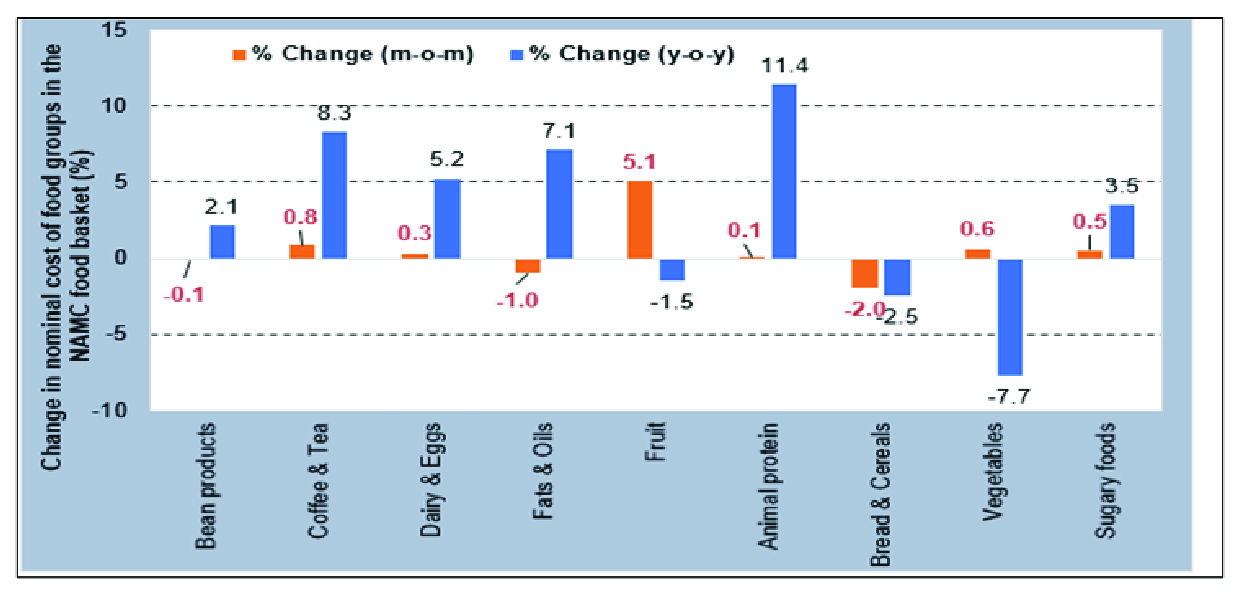
Figure 1: Nominal change in the cost of specific food groups within the NAMC`s 28-item food basket, comparing November 2025 and November 2023 versus October 2025 .
Source: Authors’ calculations based on NAMC data (2026)
3. Descriptive analysis
Descriptive evidence shows ongoing spatial price differences and significant variation across commodities, indicating uneven pressures on food affordability rather than uniform price changes. The analysis uses a straightforward descriptive approach based on observed retail prices, focusing on average rural–urban price premiums by commodity and measures of price volatility and month-on-month fluctuations. Table 1 below reveals that rural–urban price differences are mainly concentrated in a small number of commodities. Fresh chicken portions stand out as a clear outlier, with an average rural price premium of about 36 per cent and notable volatility, highlighting severe and unstable rural pricing pressures in this category. Smaller but consistent rural premiums are observed for certain beef cuts, rice, and long-life milk, which align with structural cost and distribution disadvantages rather than temporary price shocks. Conversely, several staple items show negative average premiums, indicating lower rural prices compared to urban markets. This asymmetry confirms that the rural price disadvantage is not universal but varies by commodity, emphasising the need for targeted interventions for high-premium, high-volatility food items rather than broad-based price measures
Table 1: Commodities with the largest average rural price premiums, 2024/25¹
| commodity | avg_prem~t | sd_prem~t |
| Chicken portions -fresh per kg | 35.803007 | 16.38103 |
| Beef chuck per kg | 7.0167305 | 6.4007543 |
| Beef brisket per kg | 6.0156155 | 5.6385338 |
| Rice 2kg | 4.5027265 | 1.0692714 |
| Full cream milk – long life 1ℓ | 2.8409522 | .68464591 |
| Bananas per kg | 1.6348715 | 3.3322125 |
| White sugar 2.5kg | -.40492817 | 2.3675996 |
| Brown bread 700g | -1.1269597 | .93505791 |
| White bread 700g | 1.7055571 | 1.0086725 |
| Full cream milk – fresh 2ℓ | -1.7419597 | 1.9872689 |
Source: Authors’ calculations based on monthly retail price data.
¹Note: avg_premium_pct denotes the average rural–urban retail price premium by commodity over November 2024–November 2025, calculated as the mean percentage difference between rural and urban prices. Positive values indicate higher average rural prices relative to urban markets, while negative values indicate lower average rural prices. sd_premium_pct reports the standard deviation of the rural–urban price premium, capturing the temporal variability of the spatial price differential. Results are unweighted and limited to commodities found in both rural and urban markets, emphasising clarity and policy relevance.
Table 2 below shows that food price risk mainly concentrates in animal protein markets, with beef cuts exhibiting the highest price volatility in both urban and rural areas. Urban markets experience greater overall price fluctuations, while rural markets are marked by more instability for certain commodities, indicating less predictable price formation despite lower average price increases. Additionally, increased rural volatility in fresh chicken, tinned fish, and selected horticultural products highlights vulnerabilities caused by narrow markets, storage challenges, and supply disruptions. These patterns suggest that rural food insecurity is driven not only by higher prices for specific commodities but also by increased vulnerability to short-term price shocks, emphasising the need for targeted, commodity-specific policy measures.
Table 2: Price volatility and month-on-month pressure by commodity and area²
| Area | Commodity | sd_price | avg_mom_~t | sd_mom_~t |
| Urban | Beef sirloin per kg | 23.659813 | 2.7581258 | 4.2878915 |
| Urban | Beef rump steak per kg | 22.446464 | 2.4199905 | 3.8856628 |
| Urban | Beef fillet per kg | 21.581326 | 1.5118371 | 2.8329747 |
| Urban | Beef T-bone per kg | 15.648057 | 2.1798301 | 2.6072604 |
| Rural | Beef fillet per kg | 14.627586 | .21330272 | 8.1553268 |
| Urban | Beef chuck per kg | 14.345063 | 2.2542132 | 4.1674877 |
| Urban | Beef brisket per kg | 14.183091 | 2.2212279 | 4.2069327 |
| Rural | Beef rump steak per kg | 13.723191 | 1.4917188 | 5.7491365 |
| Urban | Beef stew per kg | 13.226397 | 2.4858966 | 3.6989746 |
| Rural | Chicken portions – fresh per kg | 12.423451 | -2.5646035 | 9.6762921 |
| Urban | Beef mince per kg | 11.470095 | 2.0399818 | 2.8857612 |
| Urban | Lamb/Mutton loin chop per kg | 9.4791788 | 1.0532383 | 2.1045365 |
| Rural | Fish (excl tuna) – tinned 400g | 9.2971178 | 9.0357863 | 46.526087 |
| Rural | Beef brisket per kg | 9.0895413 | 1.3922425 | 3.5416193 |
| Urban | Lamb/Mutton rib chop per kg | 8.6847295 | 1.0142572 | 2.0044023 |
| Urban | Lamb/Mutton leg per kg | 8.4783493 | 1.1758957 | .89014365 |
| Rural | Beef chuck per kg | 8.1628527 | 1.2571454 | 3.1027025 |
| Rural | Oranges per kg | 7.8749011 | 2.0013935 | 20.624143 |
| Urban | Cheddar cheese per kg | 7.5987861 | 1.1107902 | 2.5709175 |
| Urban | Sausage per kg | 7.3171299 | .96918297 | 4.1803121 |
Source: Authors’ calculations based on monthly retail price data.
²Note: sd_price denotes the standard deviation of monthly retail (rands) prices over the period, capturing overall price volatility. avg_mom_pct reports the average month-on-month percentage change in prices, indicating the direction and magnitude of short-term price movements. sd_mom_pct denotes the standard deviation of month-on-month percentage changes, measuring the instability of short-term price adjustments. All statistics are computed using observed monthly prices over November 2024–November 2025.
3. Recommendations and conclusions
- Poultry price instability should be identified as a trade-sensitive risk. The extremely rural premium and volatility observed for fresh chicken are consistent with exposure to external supply conditions in a market where chicken imports play a material role. Trade-related disruptions, whether logistical, regulatory, or cost-driven, should be recognised as direct risks to domestic food affordability, particularly in rural areas.
- Prioritise meat/animal protein markets in trade and price surveillance. Fresh chicken and selected beef cuts account for the largest rural price premia and the highest price volatility. Food price surveillance and trade monitoring should therefore strategically prioritise animal protein markets, as aggregate food price indicators understate the pressure on these commodities. Trade disruptions and biosecurity lapses are putting immense pressure on meat prices in South Africa.
- Focus policy attention where price and trade pressure are concentrated. Strong heterogeneity across commodities implies that rural food price challenges are not broad-based. Policy responses should be targeted at high-premium, high-volatility commodities, rather than framed as economy-wide food price interventions.
In conclusion, trade disruptions have significantly affected food price pressures in South Africa during 2024/25, with impacts concentrated in specific, trade-exposed value chains rather than stemming from overall food inflation. Fresh chicken displays a notable rural price premium, while beef cuts experience the highest price volatility across markets, emphasising animal protein supply chains as the main source of spatial price stress. These patterns align with sensitivities to trade-related costs, inefficiencies in logistics, and supply side disruptions in perishable markets due to climate variability. The volatility findings also show that food price risk operates through both instability and price levels, especially in rural areas. Overall, the results indicate that aggregate food price indicators conceal underlying trade- and commodity-specific pressures, and that 2026 food prices may be affected by commodity-level dispersion and volatility within key agricultural trade and food value chains.
REFERENCES
Trade map, 2026. trademap.org. [Online] Available at: https://www.trademap.org/[Accessed 18 January 2026].
Buhlebemvelo Dube and Naledi Radebe